
Semi Truck Exhaust Manifold Buyer's Guide

This guide covers everything you need to know about aftermarket semi truck manifolds, alongside useful information about the various manifold brands we sell.
After reading, you'll be able to accurately diagnose a leak, choose between a stock replacement or a high-flow ceramic upgrade, and ensure you get the exact fitment for your engine block and chassis.
How Exhaust Manifolds Work (Quick Recap)
The manifold funnels the hot fumes from the engine’s cylinder head into a single, high-powered stream of exhaust.
The fumes are what spin the turbine wheel inside the turbocharger.
When the manifold delivers smooth, fast-moving exhaust fumes, the turbo spools up faster: leading to faster acceleration/throttle response, lower exhaust gas temps, and better fuel efficiency.
Semi truck exhaust manifolds see a ton of heat cycling, warming up and cooling down. Over time, this causes OEM single piece manifolds to warp, crack or snap their mounting studs.
This is partly why most modern manifold designs have 3-piece pulsed sections and ceramic coating, to better handle heat cycles.
The Hidden Cost of a Leaking Manifold
For an owner-operator, an exhaust manifold failure isn’t just a parts replacement; it’s a direct hit to your fuel economy and a threat to your delivery schedule.
Manifolds endure brutal heat cycling, expanding and contracting with every grade you pull. Over time, stock single-piece cast iron manifolds warp, crack, and snap their mounting studs.
When your manifold leaks, you lose turbo drive pressure. This leads to:
- Loss of turbo boost and slower throttle response
- Decreased fuel economy (MPG)
- Higher exhaust gas temperatures (EGTs)
Signs of a Problematic Manifold
- Ticking or tapping sound on startup
- Louder exhaust note under load
- Soot marks around the manifold
- Exhaust smell in or near the engine bay
- Excessive engine bay heat
- Recurring gasket failure
Signs of a High-Functioning Manifold
- Able to withstand extreme temperatures, up to 1200 to 1500F.
- Consistent boost pressure
- Stable turbo timing
- Smooth flow of exhaust
Factory vs Performance Manifolds
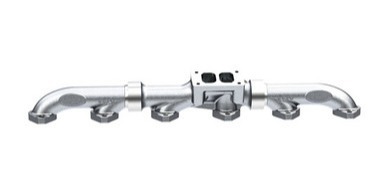
Factory manifolds are often made of cast iron.
Performance manifolds are made of high-silicone ductile iron (or high-grade stainless steel) with a ceramic coating for added heat insulation.
This stops heat from radiating into the engine bay – boosting the turbocharger’s efficiency.
Small Cam vs Large Cam Manifolds
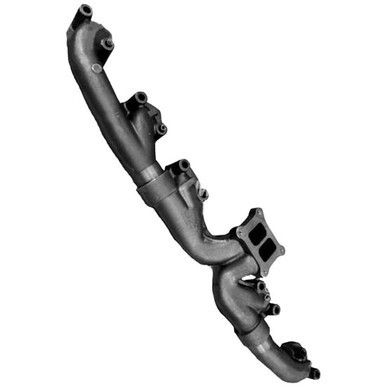
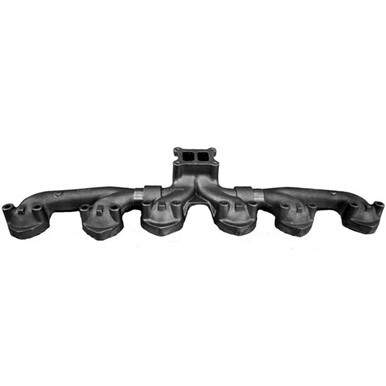
A well-matched system pairs a smaller cam with a low-to-midrange torque manifold, while a larger cam requires a high-RPM horsepower–supporting manifold.
The right setup depends on whether you want higher airflow velocity versus air flow volume.
1. Before Your Replace the Manifold, Is the Manifold Actually Failing?
Before pulling off the turbo, verify that the manifold is the actual source of the problem.
Common Symptoms of a Bad Exhaust Manifold:
- High-pitched whistling sound under load
- Ticking or tapping sound on cold startups that fades as the engine warms up
- Black soot trails around the exhaust ports or cylinder head
- Raw exhaust smell lingering in the engine bay
- Recurring manifold gasket failures
Signs That It's NOT the Manifold, but Something Else
Don't order a heavy piece of cast iron if the issue is a $50 sealing part.
Always check:
Stuck Wastegate or VGT Vanes
- Performance Lag: slow acceleration because exhaust escapes before it hits the turbo; if the wastegate is stuck open or the VGT vanes are choked, the turbo won't spool.
- Signs: a quiet truck without power is a turbo or actuator issue.
EGR Cooler/Valve Leak
- Smoke Under the Hood: visible black soot from under the hood can be a crack in the EGR cooler or bellows pipes.
- Signs: white smoke or coolant loss without any drips on the ground, the EGR cooler has an internal leak; if there is a black, slime near the EGR valve, it's an EGR failure.
Broken Exhaust Studs
- Cold Start Ticking Sound: the end studs have snapped off
- Signs: the bolt heads at the front/back of the cylinders are missing and there is metal where the nut should be; you need new spacers and hardware.
Turbo Gasket Cracks
Soot at the Cylinder Head Ports: soot around the connection point that connects the turbo and manifold together.
Signs: wipe the soot away and start the truck to see if the black soot trail starts at the 4-bolt flange under the turbo; if so, you need a new gasket.
- Blown Gaskets: Look for soot strictly at the mating surface.
- Broken Studs: A snapped bolt will cause a leak even if the manifold is perfectly sound.
- Failed Turbo Flange Connections: Check the V-band clamps and crush rings.
- EGR-Related Leaks: Ensure the soot isn't coming from the EGR cooler connection.
2. The ROI Decision: Stock Replacement vs. Performance Upgrade
When the manifold itself cracks, you have three main paths to get your rig back on the road.
Path #1: Direct Heavy-Duty Replacements (3-Piece Kits)
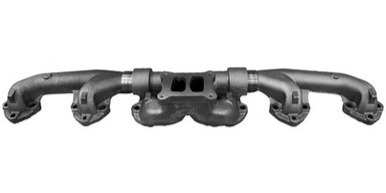
Many repair shops rely on aftermarket 3-piece modular kits (like those from BESTfit or AKMI).
- How it works: Slip joints allow the metal sections to expand and contract independently.
- Best for: Fleet maintenance buyers and owner-operators looking for a reliable, cost-effective fix that prevents the warping issues found in stock 1-piece manifolds.
Path #2: The Performance Upgrade (Ceramic-Coated)
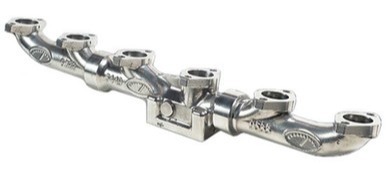
Brands like Bully Dog manufacture high-silicone ductile iron manifolds treated with advanced ceramic coatings.
- The Science: The ceramic coating traps heat inside the manifold. Hotter exhaust gas moves at a higher velocity, which spins the turbo up significantly faster.
- The Payoff: This drastically reduces acceleration lag, lowers under-hood temperatures, and can yield fractional MPG improvements.
- Best for: Heavy-haulers, performance-minded diesel enthusiasts, and owner-operators looking to lower their long-term cost per mile.
Path #3 Single-Piece Performance Setups
- How it works: A single-weld, solid unit that eliminates the slip joints completely.
- Best for: Custom builds and drivers who want to eliminate any potential joint leak points, provided the material is graded to handle the expansion without cracking.
3. The Ultimate Fitment Matrix: Getting the Right Part
You cannot order a manifold based just on your truck’s make and model. Fitment is dictated by your specific engine platform, your turbo placement, and the emissions era of your block.
Turbo Mount Positions
Look at your hood slope and frame rail clearance to identify your setup:
- High-Mount: The turbo sits above the valve cover. Common in classic, long-nose trucks (e.g., Peterbilt 379) with plenty of vertical under-hood space.
- Low-Mount: The turbo sits lower, tucked toward the frame rail. Required for aerodynamic, sloped-hood trucks (e.g., Kenworth T680, Freightliner Cascadia) and vocational chassis where overhead space is tight.
- Straight-Out (Center Mount): The flange faces outward horizontally. Common in industrial or specialized log-style applications.
The EPA-Led Emissions Era Manifolds
- Pre-EGR (Prior to 2004): Designed strictly for flow. Since they didn't deal with recirculated gas, these run cooler and last longer.
- EGR Era (2004-2007): Added a large port to route gas to the EGR cooler. This created higher backpressure and massive heat stress, making older cast-iron materials brittle and prone to cracking.
- DPF Era (2007-Present): Includes hydrocarbon injectors for regen cycles. Manifolds from this era endure extreme 1,400°F temperature spikes and require upgraded materials like Hi-Si Mo ductile iron.
4. The Hardware Trap: Why Reusing Bolts Costs Thousands
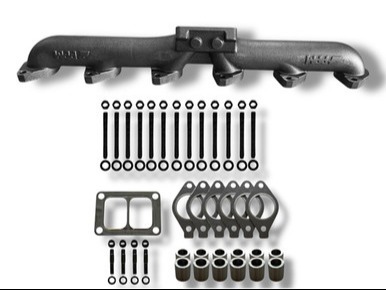
Replacing a manifold is a knuckles-busting, labor-intensive job. If a seized, heat-fatigued stud snaps off in the cylinder head during installation, your truck is down for another day while a machinist drills it out.
DO NOT reuse old hardware.
Always replace worn out:
- Exhaust Manifold Gaskets: Upgrade to multi-layer steel (MLS) or graphite composite.
- Studs, Nuts, and Spacers: Fresh hardware ensures proper torque sequence and prevents heat-warped bolts from snapping later.
- Turbo Flange Hardware: Including V-band clamps and turbo outlet adapters.
- Expansion Joints/Bellows: If applicable to your setup.
5. Shop for Manifolds by Engine Family
We stock standard and premium aftermarket manifolds from trusted brands like Bully Dog, AKMI, Automann, Power Play, and BESTfit.
- Caterpillar: C15, 3406E, ACERT, C13, C11, C7
- Cummins: ISX15, N14, NT855, M11, ISC, ISB
- Detroit Diesel: Series 60 (12.7L & 14.0L - EGR and Non-EGR)
- PACCAR / Volvo / Mack: MX13, D13, MP8
- International: DT466 and DT platforms
Caterpillar (CAT) Manifolds Sold at 4 State Trucks
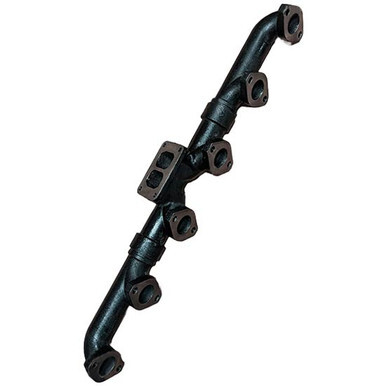
- Performance Upgrades: Bully Dog offers several ceramic-coated options for C-11, C-12, C-13, and C-15 (ACERT and non-ACERT) engines. These are designed to handle higher temperatures and improve exhaust flow.
- Standard Replacements: AKMI and BESTfit provide 3-piece kits for the 3406 series (A, B, C, and E) and C15.
- Mounting Styles: Note that there are specific designs for High Mount, Low Mount, and Straight Out configurations (e.g., Power Play Products and AKMI) to fit different chassis and turbo setups.
Cummins Manifolds Sold at 4 State Trucks
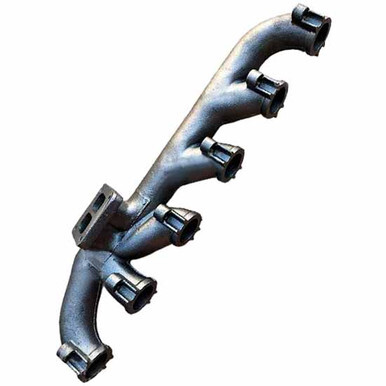
- ISX Series: This is a heavily supported category. You have options ranging from basic 3-piece BESTfit kits to high-end Bully Dog ceramic-coated units and one-piece designs from Power Play Products.
- N14 & NT855: Several 3-piece kits are available for the older Big Cam/Small Cam NT855 engines and the N14 series.
- Medium Duty: There are also direct replacements for the Cummins B, C, ISC, and ISM series, which are significantly more affordable, ranging from $239 to $545.
Detroit Diesel Manifolds
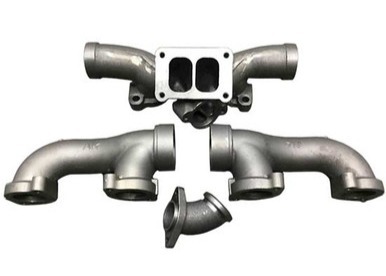
Series 60: This engine has extensive aftermarket replacement options when it comes to manifolds.
- Standard Kits: BESTfit offers multiple 3-piece kits with different center section angles (High/Flat vs. Medium Angled) at an affordable price range.
- Performance: Bully Dog's ceramic-coated options are available for 12.7L and 14.0L engines for a more premium price point.
- EGR Specific: There are dedicated manifolds for EGR-equipped 12.7L engines, priced between $534 (BESTfit - affordable alternative) and $1,975 (Bully Dog - premium brand).
PACCAR & Mack/Volvo
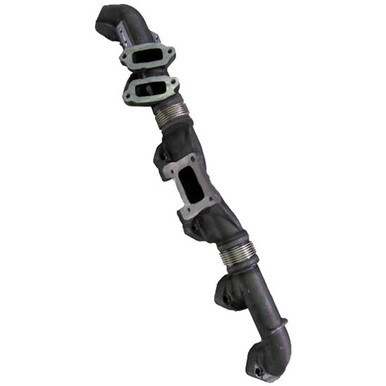
- PACCAR MX-13: Options include a BESTfit-made replacement end section ($404) or a high-performance Bully Dog ceramic-coated manifold ($1,975).
- Mack/Volvo: AKMI provides a replacement for the Volvo D13 and Mack MP8 EGR engines, and BESTfit offers a kit for Mack CH/CXN models.
Essential Hardware & Accessories
If you are performing a manifold replacement, you may also need the following listed components:
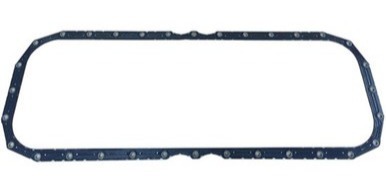
- Gasket Kits: Full Tilt Performance and Bully Dog offer manifold and turbo gasket sets (can range between $75–$77).
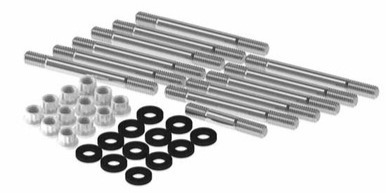
- Spacers & Studs: Stainless steel spacers for the Cummins ISX and Detroit Series 60 are available, along with CAT engine stud kits.
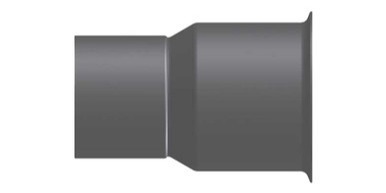
- Turbo Adapters: A variety of aluminized steel adapters and flanges are listed for various engine makes, typically priced between $25 and $75.
Note on Choose the Right Manifold: When choosing between a 3-piece and a 1-piece manifold, keep in mind that 3-piece designs allow for thermal expansion, which can help prevent cracking in high-heat applications, whereas ceramic coatings are specifically aimed at improving fuel economy and reducing turbo lag by keeping exhaust gases hot and moving quickly.
Common Manifold Components Explained
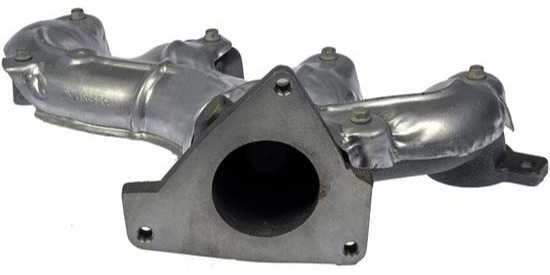
Exhaust Ports (Inlets): openings that align to the engine block’s cylinder head (inline-6 diesel engine will have six ports to pair with).
The Runners: the tubes on the manifold that lead exhaust away from the ports so that gas can flow.
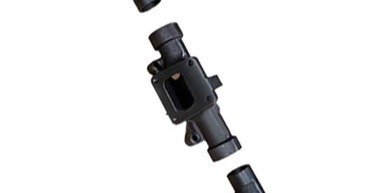
The Collector (Center Section): the central hub where all the individual runners converge. It takes abuse because it is the bottleneck where heat and pressure of the engine cylinders all meet.
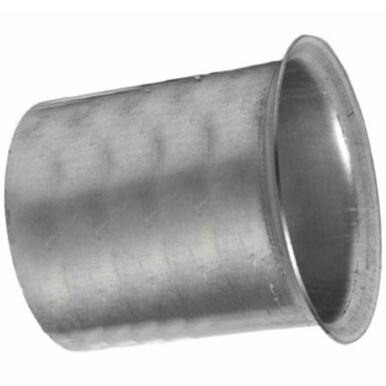
The Turbo Flange: Heavily reinforced mounting pad on the exit of the collector (where the turbocharger attaches to the manifold).
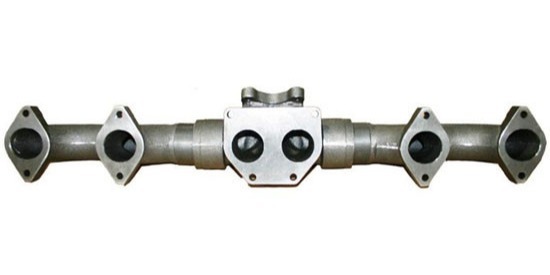
Slip Joints (Expansion Joints): heavy-duty manifolds are built using two or three separate sections that slide into each other via slip joint, allowing the metal to expand and contract when heating up and cooling off without cracking the manifold or mounting bolts.
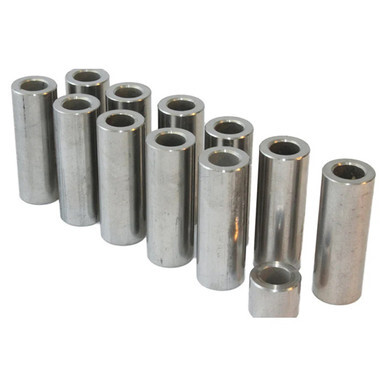
Manifold Studs & Spacers: these bolts anchor the manifold to the engine; due to high heat and stress, these bolts can snap off in the engine block.
Exhaust Manifold FAQs
Can a bad exhaust manifold cause a loss of power?
Yes. A leak reduces the exhaust drive pressure needed to spool the turbocharger, resulting in lower boost and sluggish acceleration.
Should I buy a complete 3-piece kit or just replace the cracked center section?
It is highly recommended to replace the entire assembly. If one section has heat-cycled to the point of cracking, the other sections and slip joints are likely near failure as well.
Is a ceramic-coated manifold worth the extra money?
For owner-operators planning to keep their truck long-term, yes. The heat retention improves turbo spool times and fuel efficiency, while the thermal protection drastically extends the life of the manifold itself.
Shop Semi Truck Manifolds at 4 State Trucks
Find replacement manifolds for your engine type, alongside top-tier performance manifolds to help boost performance. You can also find exhaust stacks, turbos, and replacement exhaust parts for your heavy-duty highway truck or medium-duty work truck.
Recent Posts
-
Haul of Fame: J&L Contracting's Award-Winning Truck
 Kenworths: Never Satisfied & Devilish Ways When you talk about Midwest trucking, heavy hauling, and …17th Sep 2026
 -
Semi Truck Exhaust Systems: Parts, Materials, Fitment & Repair Guide
 How a Semi Truck Exhaust System Works A heavy-duty exhaust system has three main jobs: route burned …16th Sep 2026
 -
Diesel Truck Engine Maintenance Guide
 Semi truck engines can last up to one million miles, or more, before they need to be rebuilt or repl …4th Sep 2026
 -
How to Buy the Right Peterbilt 379 Radiator
 If you want to keep your diesel engine from overheating you need a well-functioning replacement Pete …28th Aug 2026
 -
10 Essential Cost-Per-Mile Truck Upgrades that Pay for Themselves
 Small aftermarket semi truck accessories and performance upgrades save more money over time than the …21st Aug 2026
 -
Seasonal Semi Truck Maintenance Checklist
 Freezing winter weather temperatures, heavy snow, ice, and road salt take an unseen toll on your sem …14th Aug 2026
 -
Haul of Fame: Richard Bonner’s 1996 Peterbilt 379 — Bringing a Classic Trucker’s Truck Back to Life
 Every truck has a story, but some are worth taking a closer look at. Richard Bonner’s 1996 Peterbilt …14th Aug 2026
 -
Surviving the Scale: How to Pass Your DOT Inspection & Avoid Crippling Fees
 DOT semi truck inspections can make anyone nervous. There are multiple levels that start from a quic …7th Aug 2026
 -
Semi Truck Brake System Maintenance Guide
 Semi-truck brake defects account for 30% of out-of-service violations, according to CVSA’s 2025 Inte …4th Aug 2026
 -
How to Build a Semi Truck Emergency Kit (A Complete Checklist)
 Semi-truck breakdowns cost money and time; but they aren't inevitable. With the right emergency acce …30th Jul 2026