



Semi Truck Muffler Guide

Need to lower your exhaust and engine noise, but aren’t sure what muffler to get?
We offer Pittsburgh Power, Donaldson, Automann, and BESTfit mufflers.
In this quick guide, we’ll break down the basics of Class 8 semi-truck mufflers, list the top features of our aftermarket mufflers, and resonators.
When it comes to performance, the design of the muffler is just as critical as the exhaust diameter size:
Do you want more power? Get a straight-through or low-restriction X-section muffler design.
Do you want a quieter exhaust? Try a triple-tuned or chambered design.
Semi Truck Muffler Spec and Attribute Terms Reference Guide
Inlet Diameter: width of the pipe where exhaust enters the muffler. If it’s too small, flow is restricted. Too large, it won’t seal.
Outlet Diameter: width of the pipe where exhaust exists the muffler. It has to match the stack size to ensure secure fitment.
Body Diameter Maximum: the widest point across the muffler shell; this needs to match the size of the original that was removed due to mounting specifications and heat shield wrap size.
Body Length (shell length): The length of the muffler shell.
Overall Length: Total end-to-end length including the inlet/outlet pipe extensions. Critical for matching the OEM fit and affects the choice of mounting brackets.
Rated flow LR: air flow rating at low engine load/RPM. Determines how well the mufflre breathes, if it’s too low, the engine builds heat at idle, if it’s too high, excess noise occurs at low RPMs.
Rated Flow MR: flow performance at typical cruise speeds; it’s ideal for effective sound control on highway trucks.
Rated Flow HR: maximum exhaust flow capacity at high RPM/accelerations. This prevents power loss when climbing hills or carrying heavy payloads. Too high = engine working harder, generates more heat. Too low, it hurts the turbo performance or low-RPM smoothness
Back Pressure Low-Range: resistance to exhaust flow inside the muffler at each power level. Too much pressure reduces engine power and lowers MPG. The low range is the backpressure at lower RPMs.
Back Pressure Mid-Range: The resistance to exhaust flow at a mid-range level (cruising on the highway)
Back Pressure High-Rage: the level of resistance to exhaust flow when accelerating at an incline.
Attenuation LR: the level of noise removed at low RPMs, if it’s too low = loud cab
Attenuation HR: the level of noise removed at high RPMs
Common Muffler Types
Type 1: center to center – the inlet and outlet are aligned at the center on opposite ends of the muffler. By far, the most common muffler type for Class 8 semi trucks.
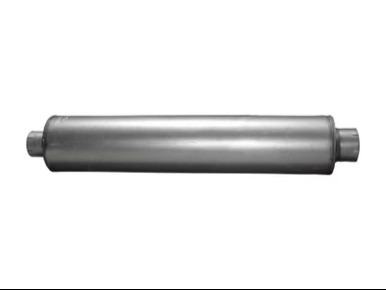
Type 2: Offset to Offset – the inlet position is offset on one end and offset on the other end as well.
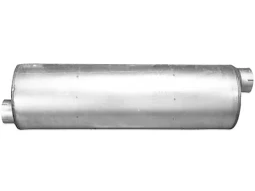
Type 3: Center to Offset – one pipe centered and the other is offset on the opposite end.
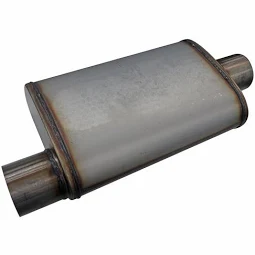
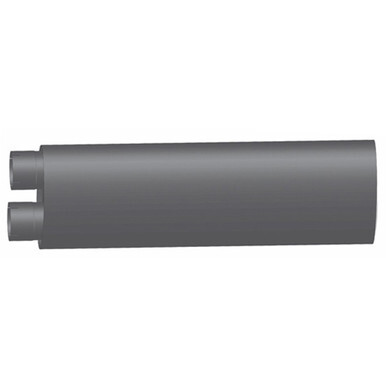
Type 4: Inlet/Outlet are next to one another on the same side end of the muffler
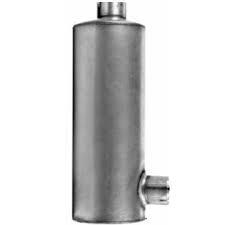
Type 5: Dual inlet to single outlet – two pipes in, and one pipe out for dual exhaust feed.
Type 6: Single Inlet to Dual outlet – one pipe in, two pipes out for split exhaust flow stack.
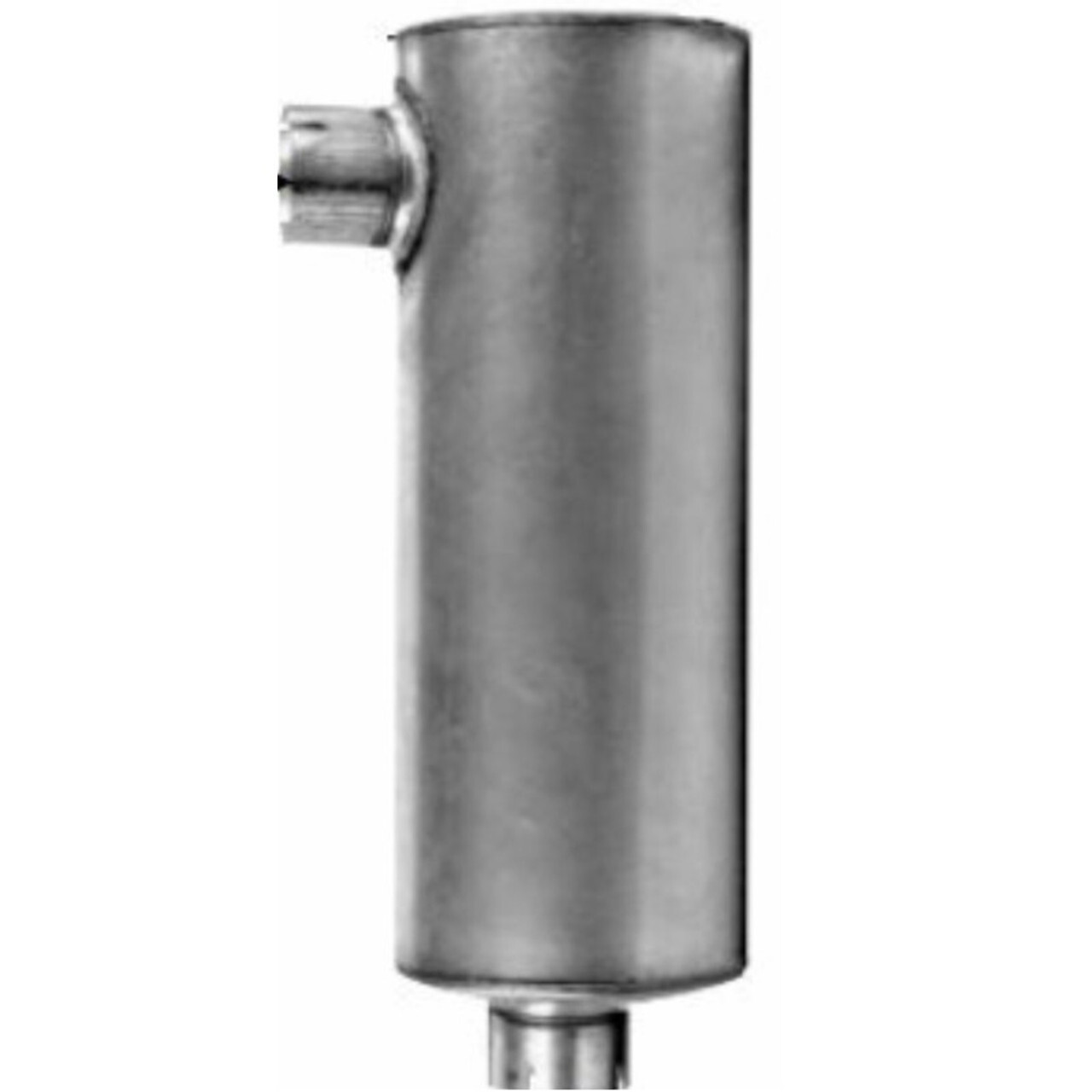
Type 9: truck muffler with the inlet on one end of the muffler and the outlet positioned at the end of the long horizontal side of the muffler, perpendicular to one another.
Shell length: The length of the muffler shell (not including the inlets/outlets)
Cross Section or “X” Section: the technical term for the internal structure of a muffler (perforated, chambered, triple-tuned, S-flow or spiral path, louvered tube, etc.) that tells you the kind of sound tuning and flow behavior that determines noise level, back pressure, flow efficiency, and exhaust brake compatibility.
Semi Truck Muffler Parts and Purposes Explained
Mufflers have two purposes: noise attenuation (dampening) and exhaust flow management.
They’re mandated by law. They cut noise by 15-25 dBA on average. They can suppress the noise from an engine brake that can be a loud sharp bark.
Mufflers achieve this by using internal baffles, chambers, and sound-absorbing materials to cancel out noise pressure.
X-Section Muffler Designs in Class 7-8 Trucks
To cut down on noise, aftermarket mufflers are primarily designed in two ways:
- Straight-Through (Absorptive) Mufflers: exhaust flows through a straight perforated pipe for a deep, mellow exhaust tone.
- Chambered (Reflective) Mufflers: exhaust flows through a series of baffles that reflect sound waves into each other canceling noise.
A lot of modern aftermarket muffler manufacturers mix these two styles.
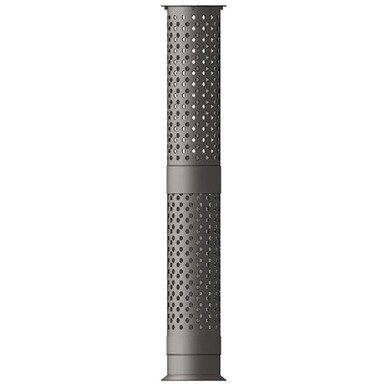
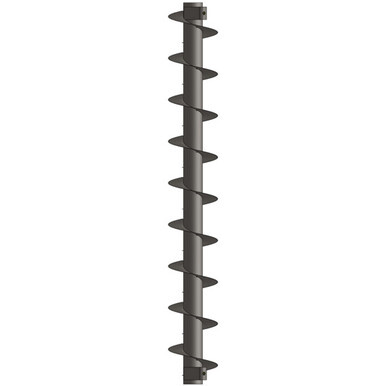
The straight-through design (maximizing exhaust flow) is combined with tuned chambers/baffles to drown out specific ranges of sound frequencies.
Patented Muffler Designs
Mufflers from popular brands, like that of Donaldson’s “Silent Partner,” or the Walker’s “Mega-Flow Noisebraker,” incorporate multi-chambered or multi-pass designs (sometimes called “three-stage muffler”) to deaden different frequencies from the exhaust sound profile.
Mufflers also help to manage backpressure. Exhaust flow moves through the muffler’s path. So, the muffler is designed to avoid creating excessive restriction while still minimizing noise levels.
Now, if too much backpressure occurs, the exhaust gas can’t escape, and the engine’s power is decreased. Bad news.
Resonators vs Mufflers

The resonator is a secondary sound tuning device that is a smaller chamber or section of pipe created to eliminate drone or hum frequencies.
Not all semi truck mufflers have resonators.
Some aftermarket exhaust kits add a resonator to fine-tune the sound profile by adjusting for particular sound waves.
The muffler is there just to reduce the volume of noise. A lot of aftermarket mufflers have resonator chambers incorporated into the design, eliminating the need for a resonator.
Mufflers are placed directly into the exhaust piping and are exposed to tremendous heat.
They are either stainless steel (higher price) or steel coated with aluminum-silicon-alloy material (lower price).
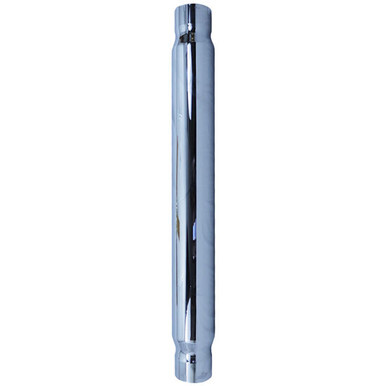
The thickness and welding of the muffler matters. Commercial Class-8 truck mufflers use 10-inch or larger diameter shells with internal continuous weld baffles for added durability.
Diesel truck engines vibrate constantly so mufflers are designed to have strong inlet/outlet necks (sometimes bridge constructed) to prevent cracking over time.
The mounting brackets and reinforced hanger points ensure the muffler can be supported on the chassis.
Some performance mufflers, for example, are constructed with a perforated core that has fiberglass wrapping. This resists blowout and better absorbs noise.
The Best Semi Truck Mufflers
There are plenty of reputable aftermarket manufacturers on the market.
According to driver reviews, it’s a mixed bag. Some swear by a particular brand, others hate it, and others don’t see any difference.
Best Budget-Friendly Mufflers
BESTfit is going to be the number one pick if you want a relatively budget-friendly option.
This is a solid, middle-of-the-road truck parts brand that includes well-liked product lines like the 5-inch inlet/outlet round mufflers in 10x51 9x30 sizes.
Within the BESTfit lineup are high flow mufflers that features a 10x51 inch size and a 5 inch inlet/outlet offering a deeper sound and strong exhaust flow.
Automann is a great dealer with truly competitive price points when compared to heavy-hitter name brands like Donaldson and Walker.
Semi Truck Performance Mufflers
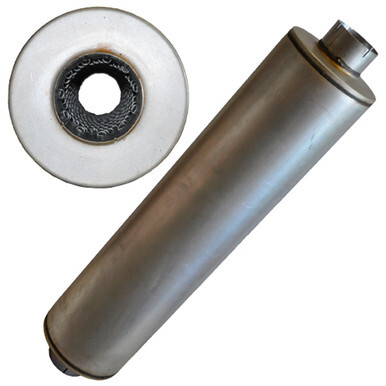
If you crave a bit more horsepower, stronger torque, and a throatier sound, buy a performance muffler.
Performance mufflers feature straight-through designs to maximize exhaust flow and mitigate backpressure so that the engine can breathe, all while still dampening noise enough to meet regulatory requirements.
Specifically, the mufflers designed by Pittsburgh Power allow for a greatly improved exhaust gas output.
Their 10-inch diameter, 5-inch inlet/outlet “free-flow mufflers” are popular among owner-operators who want stronger performance.
During testing, these 5” mufflers achieved up to 50% HP increases and a .25 MPG improvement due to a reduction in backpressure.
Pittsburgh Power also offers a blend of quiet and high-performance with their “Quiet Performance” muffler. This model offers drivers the power gains they want, but with a less aggressive sound profile.
Donaldson, on the other hand, doesn’t expressly market “high-performance mufflers.” But they are well-constructed OEM-grade replacements designed to free up exhaust flow.
In other words, Donaldson mufflers are a great alternative to Pittsburgh Power.
The Best Semi Truck High-Flow Mufflers
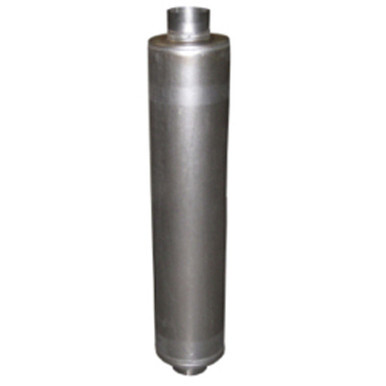
Some mufflers are marketed as “high-flow” or low-backpressure” – they list a flow or CFM rating. These are designed to maximize exhaust flow and tone while reducing backpressure.
A 10” muffler can flow around 2,200-2,800 CFM cubic feet per minute of exhaust gas. If your engine has been updated for higher output, ensure that the muffler is also upgraded to absorb enough noise.
The Quietest Semi Truck Mufflers
Want the quietest muffler? Look for brands that use “quiet” in their product label or incorporate a lot of noise-reduction technologies.
TIP: If your goal is to lower unwanted engine and brake noise without choking the engine, consider Donaldson mufflers.
Another popular choice is Walker mufflers which come with their own proprietary in-build tech, like triple tuning chamber noise reduction.
If you need a low-noise semi-truck muffler on a budget, consider the BESTfit-line of mufflers.
How to Choose the Right Muffler for Your Semi Truck
Buying the correct muffler helps you get the right installation done the first time – without the potential course of action involving exhaust pipe modifications.
- Prioritize whether you need more noise reduction or flow performance.
- Measure your existing setup.
- Decide on the sound profile you want. Is it a deep rumble, mid-range hum, or as close to quiet as possible?
Admittedly, the “sound” is mostly determined by the pipes, not the muffler. However, the muffler still plays a role in your overall exhaust sound profile.
Do this before you buy:
Get Measurements
- Match the inlet/outlet diameter to your truck’s exhaust.
- Check the muffler length and shell size for mounting bracket compatibility.
- Pick the right flow ratings (based on your hauling profile:
- HR = trucking high-incline mountainous terrain.
- MR = for flatland highway cruising.
Choose the Muffler Type
Check the orientation of your muffler: What's the Type?
Some old-school semi trucks have dual exhaust stacks. In this case, you would obviously need to buy two mufflers instead of one.
Some muffler styles have the inlet/outlet on opposite ends at offset positions, while others, like Type 1 vertical stack mufflers, feature the inlet/outlet aligned to the center on opposite ends.
Other mufflers integrate resonators and spark arrestors for specialized off-road applications, for example, logging operations.
Semi Truck Muffler Clamps & Brackets
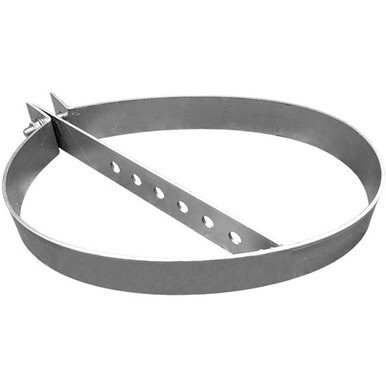
Clamps are used to effectively seal muffler inlets, outlets, elbow joints, and other exhaust system connections.
They are constructed from stainless steel or aluminized steel material in order to withstand the dramatic and frequent temperature changes.
Sealed clamps are, by far, the easiest to install because they don’t require you to weld or disconnect your exhaust system.
TIP: Some drivers use zinc-plated steel rain caps to keep rainwater from entering their exhaust stacks while they’re parked or idle.
Shop for Replacement Semi Truck Mufflers at 4 State Trucks
Upgrade to a performance muffler or overhaul your entire exhaust system with new chrome stacks, y-pipes, mounting brackets, and more. Check out the 4 State Trucks Mobile App for convenient, on-the-go shopping.
Recent Posts
-
5 Semi Truck Spring Cleaning & Maintenance Tips for Owner-Operators
 The spring season is one of the best times to check on the functionality of your semi truck, especia …13th Mar 2026
 -
I-65 Chrome Shop Becomes an Authorized Dealer of 4 State Trucks: Expanding Access to Semi Truck Parts in Indiana
 Owner-operators, fleets, and repair shops across the Midwest now have expanded access to one of the …10th Mar 2026
 -
A Handshake Across the Border: 4 State Trucks Expands into Canada with Soaring Eagle
 In trucking, growth doesn’t just happen in boardrooms. It happens in shops. On backroads. In early-m …9th Mar 2026
 -
Two Family Businesses, One Goal: Taking Care of Truckers
 In trucking, reputation isn’t built overnight. It’s built mile after mile, handshake after handshake …6th Mar 2026
 -
Ultimate Guide to Semi Truck Fifth Wheels
 The reality is, a truly comprehensive semi truck fifth wheel guide would be volumes, novellas even. …6th Mar 2026
 -
7 Chrome Mud Flap Weight Styles that Add Personality to Your Rig
 Chrome mud flap weights are an affordable way to add a light touch of style to the rear of your big …27th Feb 2026
 -
Haul of Fame: The Story Behind Mies & Sons’ “Mooving Violation"
 His childhood was on a dairy farm. His adulthood was behind the wheel of a semi. Jerry Mies’ “Moovin …20th Feb 2026
 -
Signs of a Failing Heater Box & What to Do About It
 Experiencing refreshing cool air in the summer and warm air in the winter is nearly priceless when b …20th Feb 2026
 -
13 Must-Have Kenworth Chrome Accessories (For Any Budget)
 If you're looking for the perfect aftermarket chrome upgrades to give your Kenworth a polished, slee …13th Feb 2026
 -
What Makes This Joplin Semi Truck Show the Most Unique in America?
 What makes a semi truck show truly unique? The events? The custom truck builds? The general vibes? T …6th Feb 2026