
Ultimate Guide to Semi Truck Fifth Wheels
The reality is, a truly comprehensive semi truck fifth wheel guide would be volumes, novellas even.
However, here's a broad overview of fifth wheels on semi trucks.
What is a Semi Truck Fifth Wheel?
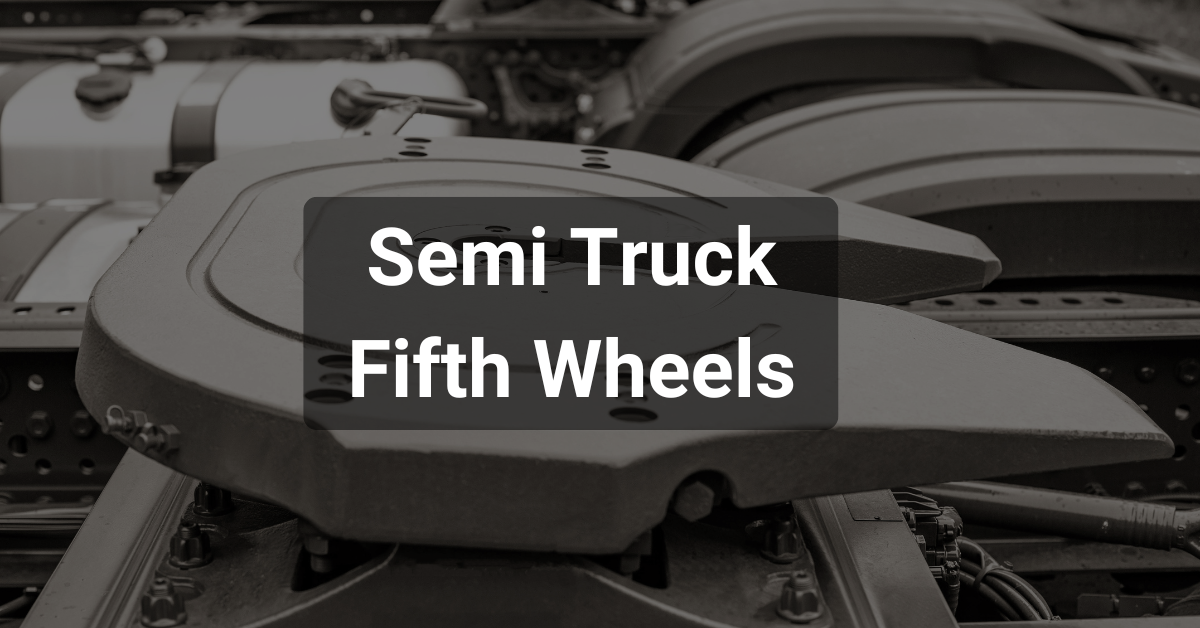
A semi truck fifth wheel is basically a hinged plate with a locking mechanism that’s mounted to a slider/base which bolts to the frame.
The kingpin slides into the throat, the lock holds it, and the whole assembly pivots during turns.
The fifth wheel can be considered the sum of 3 linked systems:
- Coupler and lock
- Mount and slider
- Wear control components (bushings, fasteners, lube, tools, liners)
The symptoms of a worn fifth wheel or damaged fifth wheel components become unignorable: loud clunking, excess sway, hard coupling, uneven wear, and poor handling.
Worn hardware components like bushings/liners, locks, or loose mounts can mean clunking, sagging, and jerking on takeoff.
What Semi Truck Fifth Wheel Brands are the Best?
As far as the best brands? They're all pretty much the same. Holland is the biggest name; 80% of new trucks come with a Holland model fifth wheel.
Fifth Wheel Basics: What it Does & Why
Kingpin:
The kingpin is the hardened steel pin mounted under the trailer. It’s the “male” part of the connection. When you back under the trailer, the kingpin is what enters the fifth wheel.
What matters here:
- The kingpin has shoulders/geometry that the lock is designed to capture.
- If the kingpin is badly worn, bent, or out-of-spec, even a properly adjusted fifth wheel can feel loose or may not lock correctly.
Throat:
The throat is the open “mouth” of the fifth wheel top plate. As you back up:
- The kingpin is guided into the throat by the plate shape and guide surfaces.
- The fifth wheel is normally tilted slightly so the trailer’s skid plate rides up onto the top plate (this helps alignment and seating).
If the throat area is damaged or excessively worn, the kingpin may not feed smoothly and coupling can become inconsistent.
Lock:
Once the kingpin reaches the correct position in the throat, the locking system closes around it. Different brands do this differently, but the principle is the same:
- The lock mechanism closes behind the kingpin so it cannot pull back out.
- The handle should return to its “locked” position, and many designs have a visible indicator or a feel/position that confirms lock engagement.
What “good lock” looks like in practice:
- The kingpin is fully seated.
- The lock components are fully engaged (not partially caught).
- The handle is fully in (not hovering/half-out).
- There’s no abnormal free play when you do a proper tug test.
Secondary safety (what keeps a “nearly locked” situation from becoming a disaster):
Most modern fifth wheel designs include secondary safety features that help prevent two dangerous events:
- High hitch / false coupling: when the trailer isn’t fully seated on the fifth wheel (too high), and the kingpin can be “caught” incorrectly.
- Accidental release: when vibration or load could otherwise allow a partially engaged mechanism to open.
Secondary safety features vary by brand/model, but commonly include:
- Guard features that discourage “high hitch” engagement
- Secondary locks that prevent the handle from opening unless the mechanism is truly in the released state
- Positive lock designs (multi-point lock, lock indicators)
How the Fifth Wheel Position Impacts Axle Weight & Handling
A sliding fifth wheel lets you move the coupling point forward or backward on the tractor frame. That changes how much trailer weight is carried by:
- the steer axle (front axle)
- the drive axles (rear tractor axles)
The fifth wheel is a load transfer point that acts like a lever.
Moving it:
- Forward: means more weight shifts onto the steer axle and typically off the drive axles.
- Backward: means more weight shifts onto the drive axles and typically off the steer axle.
This matters because the legal axle limits and handling are dependent on the distribution.
If the fifth wheel is too far back (steer axle too light):
- steering can feel light or vague
- higher risk of understeer or poor control in rain/wind
- can feel “floaty” up front
If the fifth wheel is too far forward (steer axle heavy / drives light):
- steering can feel heavier
- drives may have less traction under certain conditions (especially if you’ve shifted too much away from them)
- can affect ride and braking balance
Stability and trailer behavior:
Fifth wheel position also changes how the trailer’s forces act on the tractor:
- A position that leaves the tractor poorly balanced can amplify push/pull effects, especially during braking or in crosswinds.
- Too much load bias one way can contribute to fatigue and wear (tires, suspension, bushings), and can make the whole rig feel less settled.
Practical reasons drivers adjust the slider:
- To stay legal (axle weights)
- To optimize handling for a specific trailer/load combo
- To reduce tire wear caused by bad distribution
- To improve traction when conditions change
Key point: sliding the fifth wheel is not about fixing kingpin “slack.” It’s about weight distribution and stability.
Slack/clunk is usually a lock/wear issue; stability and axle weights are usually a slider position issue.
Common Types of Fifth Wheels for Semi Trucks
Fixed Fifth Wheel (Stationary Mount)
A stationary fifth wheel is locked in place to handle the same load profile and axle weight distribution repeatedly.
Best for:
- Dedicated routes and consistent trailer setups (same trailer length/type most of the time)
- Fleets that don’t need frequent weight shifting between steer and drive axles
Pros:
- Fewer moving parts (less to maintain than sliders)
- Generally lighter and simpler than sliding setups
Cons:
- Limited ability to adjust axle weights when load distribution changes
- Less flexible if you pull multiple trailer types or varying loads
Sliding Fifth Wheel (Adjustable Mount)
This is an adjustable fifth wheel setup that can fine-tune axle weight distribution (steer vs drives) to handle a variety of load weights. It’s mounted on rails that let it slide forward and backwards onto the tractor’s frame.
Best for:
- Drivers pulling different trailer types, lengths, or load distributions
- Staying compliant with axle weight limits
- Loads that vary day-to-day
Pros:
- More flexibility for legal axle weights and stability
- Better adaptability to mixed freight and mixed trailers
Cons:
- More components to maintain (rails, pins/wedges, air lines/cylinders on air-slide models)
- Can develop wear and play if not lubricated/inspected properly
Manual Release Fifth Wheels
Standard fifth wheels use a mechanical release handle that pulls the locking mechanism open.
How it works:
The handle is pulled, opening the lock so that the kingpin can exit the throat. Pushing the handle closes the lock for coupling the trailer.
Best for:
- Drivers who want a straightforward, dependable release system
- Trucks that don’t require in-cab air release features
Pros:
- Simple, dependable mechanism
- No air valves/cylinders needed for release function
Cons:
- Requires getting out of the cab for coupling/uncoupling
- Can be harder to operate when components are dry, worn, or misadjusted
Air Release Fifth Wheels (Air Actuated Release)
This type of fifth wheel uses air pressure to release the lock. It uses an air cylinder controlled from inside the cab or via an air valve.
How it Works:
Activate air release which causes the cylinder to move the linkage/handle, opening the lock.
Deactivating the air release means that the mechanism returns to locked position (depending on model).
Ideal for:
- Frequent trailer swaps (yard work, multi-stop, drop-and-hook)
- Fleets prioritizing convenience and reducing time spent outside the cab
Pros:
- Faster coupling/uncoupling workflow
- Less physical strain on the driver
- Helpful in winter conditions when mechanisms may be stiff
Cons:
- More components that can fail (air lines, valves, cylinder, linkage)
- Air leaks or low air pressure can cause incomplete release or inconsistent operation
- Still requires proper lock verification to prevent false coupling
No-Tilt/Blocked Fifth Wheels
A no-tilt fifth wheel restricts the rocking or tilting movement. The articulation for handling turns and maneuvering occurs at the neck.
This is used on specialized vocational setups and certain working conditions – not on standard highway trucks.
Inboard Sliders
It’s a compact, integrated style in which the sliding rails and locking mechanism are placed between the frame rails (or located closer toward the centerline of the truck).
Best for:
- Cleaner install and frame packaging needs
- Fleets wanting a more “integrated” slider footprint
Pros:
- Compact layout; often cleaner-looking install
- Can reduce snag points and protect components
- Depending on design, can simplify some service access
Cons:
- Fitment can be more specific to the tractor/frame layout
- Certain repairs can be tighter to access due to packaging
Outboard Sliders
A widely-used rail-and-slider setup that positions the rails and brackets along the outer edges of the frame rails.
Best for:
- Broad compatibility and common service parts availability
- Traditional slider setups where fleets want proven, widely serviced designs
Pros:
- Very common configuration (widely supported, easier to source parts)
- Often straightforward to inspect locking pins/wedges and rail condition
- Common travel lengths available (24", 36", etc.)
Cons:
- More exposed components (rails/pins can see more road grime and corrosion)
- More points that can wear and introduce play if not maintained
Components of a Fifth Wheel
The Fifth Wheel Top Plate
A horseshoe-shaped plate that acts as a holding point for the trailer’s kingpin. Many accessories can be placed on this plate, for specialized towing and maneuvering.
For example, a fifth wheel wrecker boom is a removable hydraulic towing attachment that mounts to the plate to tow other semi tractor-trailers, buses, or commercial trucks.
Fifth Wheel Plate Components
- Lockjaw: the locking “clamp” that grips the trailer’s kingpin inside the fifth wheel throat, keeping the trailer securely attached during pulling, braking, and turning.
- Spring: provides the force that returns and holds lock components in the correct position (locked or released), helping the jaws engage properly and keeping the mechanism from drifting.
- Bushings: wear sleeves/cushions at pivot and mount points that reduce metal-to-metal contact, absorb vibration, and keep the fifth wheel tight and aligned to prevent slop.
- Release Handle: the lever the driver pulls (or an air cylinder pulls on air-release models) to open the locking mechanism so the kingpin can be uncoupled.
- Hitch Head: guides the kingpin into the throat using jaws/lock bar/wedge.
- Base: the head rests here and allows for the hitch to articulate (forward/back and side-to-side).
- Frame Rails (Truck Chassis): these are the main structural rails of the tractor. Fifth wheel mounts bolt to these (directly or through bracket systems).
- Slider Rails: if the truck has a sliding fifth wheel, it rides on slider rails and locks into set positions (often in increments).
- Skid plate (trailer): the flat plate that slides on the fifth wheel top plate
- Grease grooves / lube system / slick plate: reduces friction and wear
- Risers / bracket heights: sets coupling height and trailer level
- Pivot bushings / pocket inserts: control slop and absorb vibration
- Fasteners & retention hardware: bolt kits, jam nuts, retaining rings—keep alignment and settings stable
- Lock tester / kingpin gauge (service tools): confirm proper adjustment and wear condition
When these core components don’t operate correctly, it can lead to a disconnected trailer.
It’s important to check if the lockjaws are loose, and if the kingpin wears down and loosens, the connected trailer will disconnect completely.
The Best Semi Truck Fifth Wheel Brands for Durability
The biggest players in the market are SAF-Holland, JOST International, and Fontaine.
The Best Heavy Duty Fifth Wheel for Steep Grades
Prioritize fifth wheels with a high drawbar pull and max vertical load for severe on/off highway hauling. Features like secondary locks, forged machine lock jaw, and lock adjustment helps to keep the kingpin connection as tight as possible even as wear develops over time.
Some examples of fifth wheel products for steep grades include:
- SAF-HOLLAND HOLLAND FW70 (severe duty)
- SAF-HOLLAND SDS (Severe-Duty Slider) system + FW70 (for slider setups) ***12K used!
- Fontaine No-Slack H7
Average Cost to Replace a Worn Fifth Wheel Assembly
If you’re buying a replacement for your entire fifth wheel assembly, it will usually cost between $5,000 – $12,000 (or much more).
Common Issues with Semi Truck Fifth Wheels
- Excessive movement / clunk between kingpin and fifth wheel (“slack”)
- Usually caused by lock needing adjustment, lock wear beyond adjustment, or a loose/worn kingpin. Holland troubleshooting explicitly calls out “lock requires adjustment,” “cannot be adjusted further (rebuild),” and “kingpin worn/loose.”
Slider won’t release or won’t move:
- Load is still on the locking pins/wedges (tractor/trailer tension)
- Corrosion/contamination in the slide mechanism
- Air cylinder not actuating (leak, stuck cylinder, low air)
Slider “unlocks” but won’t re-lock (partial engagement): Locking members not fully extended into the rail holes/notches
Fontaine’s maintenance text explicitly warns to ensure the switch is locked and locking members are fully extended into the slide rail before the truck leaves.
Air slide cylinder leaks / slow actuation: Holland maintenance procedures include cycling the cylinder and (for some slider systems) adding a small amount of air tool oil through the supply fitting to restore smooth operation and verify proper function.
Excess play / “walking” on the rails: Worn rail liners, worn pins/wedges/plungers, or damaged stops.
Common Issues with Air Slide Fifth Wheels
Won’t release / intermittent release: Air leak, kinked line, valve issue, weak cylinder, frozen moisture in lines (winter)
Partial release leading to binding: Air system moves linkage partway but doesn’t fully open the lock → “fights” the kingpin and feels stuck.
Common Issues with Fontaine No-Slack Style Locks
Hard-to-open conditions (binding against the kingpin): Fontaine notes that because the lock is designed to remove slack, it can occasionally bind and become hard to open; the bulletin explains the adjustment rod can also help free a hard-to-open lock.
Excessive slack that won’t adjust out: Fontaine notes that if re-adjustment doesn’t remove slack, it may be time to rebuild and inspect for excessive wear (they even reference rebuild kit pathways).
Incorrect wedge-stop rod free travel: Fontaine service guidance commonly targets ~1/4 inch free play and warns that misadjustment can cause slack/premature wear or binding that makes the wheel very hard to open.
Common Issues with Manual Jaw Lock Fifth Wheels
Lock too loose / too tight (misadjusted): JOST’s lock tester instructions define “too loose” as fore–aft play and “too tight” as the tester not rotating freely, and gives a corrective adjuster screw direction for each condition.
Release handle won’t stay in / snaps back / won’t seat: Often tied to misadjustment (too tight), worn internal components, or damaged/binding linkage.
Hard to open / hard to release: Can be caused by binding lock components, inadequate lubrication, or misadjustment—especially on locks that use a wedge design.
Lubrication Issues with a Fifth Wheel
Hard steering/binding and accelerated wear: Lack of lubrication on the top surface is a known cause of binding in manufacturer troubleshooting guidance.
Rapid wear on lock/pivot components: High friction increases shock loads through bushings, pins, and the lock.
Semi Truck Fifth Wheel Maintenance Steps
Pre-Trip Inspection Tips:
- Confirm proper coupling: visually verify the lock is fully engaged and the release handle is fully retracted/returned (not “half out”).
- Do a tug test (gently pull against trailer brakes) and re-check lock/handle position.
- Quick condition check: look for missing/damaged hardware, obvious cracks, bent parts, and unusual movement.
1) Start with safety setup (every time you inspect)
- Park on level ground, set tractor + trailer brakes, chock wheels if needed.
- Keep hands clear of pinch points around the lock, slider pins, and release linkage.
2) Pre-trip quick check (daily / every hook)
Purpose: confirm you’re properly coupled and nothing is visibly unsafe.
- Verify coupling
- Look for a fully seated kingpin (no high hitch).
- Confirm the release handle is fully in and the lock is engaged.
- Do a gentle tug test (pull against trailer brakes).
- Top plate surface
- Check for dryness, heavy rust, or galling/scoring (signs of poor lubrication).
- Obvious damage
- Scan for cracks, missing parts, bent release handle/linkage, or loose mounting hardware.
- Air lines (if air slide / air release)
- Listen for leaks; ensure airlines aren’t chafed or kinked.
3) Clean + lubricate (weekly, or more often in harsh conditions)
Purpose: reduce friction, prevent binding, and slow wear.
- Clean the plate (scrape off grit and old contaminated grease).
- Grease the top plate (even coverage—especially where the trailer skid plate rides).
- Grease the lock mechanism (through the provided grease zerks, if equipped).
- Grease pivot points (rocking pivots, bushings, slider components—per your model).
- If using a slick plate/lube disk, inspect it for cracking, missing clips/bolts, and correct seating.
Tip: “Low-lube/no-lube” doesn’t mean “no maintenance.” You still inspect the surface and lubricate the lock and other grease points as required by the manufacturer.
4) Inspect wear items (monthly)
Purpose: notice “ghost slack” before it turns into clunks, uncoupling risk, or broken parts.
- Lock wear signs
- Excess fore/aft play at the kingpin connection
- Abnormal clunk on start/stop
- Difficult coupling/uncoupling
- Bushings / liners / pins
- Look for elongated holes, cracked bushings, missing cushions, worn liners, excessive movement.
- Mounting hardware
- Check for loose bolts, cracked brackets, shifted mounts (follow manufacturer torque specs).
5) Slider system maintenance (monthly / quarterly, if sliding)
Purpose: ensure it slides smoothly and locks fully every time.
- Inspect rails, holes/notches, and locking pins/wedges/plungers for wear.
- Confirm the slider locks fully on both sides (no partial engagement).
- Check air slide cylinder operation (if equipped) and look for leaks/slow actuation.
6) Adjustment verification (quarterly or when symptoms appear)
Purpose: keep the lock tight without binding.
- If you notice slack or coupling issues, verify lock adjustment using the correct method for your brand/model:
- Many designs use a lock tester (best practice for accurate adjustment).
- Fontaine No-Slack style systems often involve correct wedge stop rod/adjustment rod free travel.
- If the fifth wheel cannot be adjusted further, that’s typically a rebuild/replace scenario.
7) Annual / major service (or at set mileage intervals)
Purpose: reset wear parts before failure.
- Perform a deeper inspection, often including:
- Lock rebuild kits (jaws/wedges/springs/handles as needed)
- Replacement of worn bushings, pins, liners
- Air cylinder/valve refresh if leaking or weak
- Document inspections and component replacements (especially for fleets).
Simple Steps for Fifth Wheel Lubrication
Grease is important to the proper function of the fifth wheel. The fifth wheel has plenty of grease on it to keep metal-on-metal from grinding – especially on frequent turns.
Drivers use grease packs to slide on the top of the fifth wheel to make sure it’s properly lubricated before attaching a trailer hitch.
- Park safe + unload the connection
Level ground, set brakes, chock wheels.
If you’re uncoupled, keep the fifth wheel unloaded when greasing bearings/zerks (many procedures assume no load).
- Clean first (don’t grease over grit)
Scrape/wipe off old grease, sand, and debris from the top plate contact surface and the throat/jaw area.
- Grease the top plate contact surface (standard greased wheels)
Fill the grease grooves/channels and apply a fresh coat of water-resistant lithium-based grease (often specified with EP/high-pressure capability).
If you have a Low-Lube / NoLube fifth wheel, the top plate-to-trailer surface may not require grease—follow that design’s guidance instead.
- Lubricate the kingpin lock (jaw/wedge/lock bar area)
Grease the jaw/wedge and throat area (many OEM procedures say to press grease into the serrated jaw/wedge surfaces and then cycle the lock open/closed to spread it).
- Hit the grease zerks (if equipped)
Grease the lock through the zerk fitting on the skirt/side of the top plate where provided.
- Oil the moving parts underneath
Use a light oil on linkages, pivots/cam track areas (per manufacturer guidance) so the handle and lock motion stays smooth.
- Sliding fifth wheel? Lube the slide path
Keep the slider/rail contact areas lubricated per the maker’s instructions (some guidance calls for lubricating the slide path to reduce binding and wear).
- Cycle + verify
Work the release handle/air release a few times and visually confirm smooth operation (and that grease has distributed).
Wipe off excess grease that could sling onto the frame/air lines.
Common Fifth Wheel Parts and How They Work Together
At 4 State Trucks, we don't offer fifth wheel assemblies and mounting. However, we can get a full set ordered for you.
Complete Systems: Holland Aluminum & Steel Assemblies (Inboard/Outboard), Jost Sliding Assemblies.
Slider Bases & Rails: Holland 24" Travel Bases, Fontaine 36" Slider Rails, SAF Holland ILS Slide Bases.
These parts provide the track and the locking pins/wedges to hold the fifth wheel in a secure position.
Risers & Brackets: Holland 9" Risers, Fontaine 8.75" Air Slide Brackets, Jost 8.75" Risers, Non-Slider Mounting Brackets.
Air Systems: Coiled air lines for slide cylinders, Velvac Air Cylinders (XA-2524-R).
Fifth Wheel Top Plates & Lube Solutions
Top Plates: Jost JSK37USL, Holland FW35/FW3501 replacements, Fontaine Cast/Stamped Steel Plates.
Lube Disks (Slick Plates): Minimizer 32" Poly Disks, Automann 24"/36" Graphite Disks, 1/4" Self-Lubricating Slick Plates.
Mounting Hardware: Slick plate mounting kits (Ram Bars), hardware kits with bolts, and steel retention clips.
If you're an owner-operator with his own truck and trailer, you can use a no-lube fifth wheel - no grease, no big mess. The wheel itself is like a polymer cutting board. If you put grease on it, you destroy it. The self-lubricating slick plate acts as a full replacement.
Rebuild Kits & Critical Internal Components
We also sell fifth wheel rebuild kits. A lot of drivers (and a lot of mechanic shops) don't want to rebuild it. It's messy, greasy, and tedious. You have to repeatedly steam clean before you can even begin replacing the part. It's time consuming, and expensive, between $7-10k for a fifth wheel and $1k worth of rebuild parts.
The other option: spend $5k on a kit and get greasy...
Major Rebuild Kits: Holland LH Release kits (RK17AL), SAF Holland/Neway Driver Side kits (RKFWSAL), Automann adjustment rod kits.
Locking Mechanisms: Jost Driver Side Lock Jaws (1770SK1489LZ), Fontaine Wedge Stop Rods, Jost Adjusting Screws.
Release Handles: Fontaine Oval Handles, Jost Driver Side Hand Levers, Fontaine Pull Handle Kits.
Springs & Pins: Fontaine Spring Kits, Holland Inboard/Outboard Spring Stops, 5th Wheel Roll Pins.
These parts are the safety-critical lock that actually keeps the trailer attached so that it doesn't slide away while driving:
- Lock jaws / lock bars / wedges: clamp the kingpin.
- Adjustment screws/rods + jam nuts/nylon collars: take up wear so the lock stays tight.
- Springs: return mechanisms to the correct locked/unlocked positions.
- Release handles / pull handle kits: mechanical interface for coupling/uncoupling.
- Air-release components (where applicable): shift the “release action” from manual to pneumatic.
How they impact the rest of the rig:
If the lock is too loose, you get:
- clunk/bang on starts/stops
- accelerated kingpin wear
- wear propagation into mounts and bushings due to impact loading
If the lock is too tight, you get:
- hard coupling/uncoupling
- handle won’t seat / bind
- risk of “I forced it” damage to linkages and internal springs
- Some systems (notably Fontaine No-Slack style mechanisms) depend on the correct free travel setting for the wedge stop rod/adjustment rod to let the mechanism self-compensate. Set wrong → it loses the “self-adjusting” advantage.
Symptoms of Poor Connections:
Handle snaps back / won’t stay in → spring/linkage/adjustment issue.
Visible gap or movement at kingpin → lock wear, kingpin wear, or misadjustment.
False coupling risk increases when lock components are worn or misadjusted (even if it “sounds” locked).
Bushings, Pins & Pivot Hardware to Hold it Together
Bushing kits are frequently used to help rebuild a busted top plate. To find the right size, you need the model number. Your model number is on the side of the fifth wheel, as these things wear down fast. If you need more slide, a light duty or a heavy duty fifth wheel is best.
Bushings: Polypropylene/Polyurethane bushings for Holland, Jost (SK290594), and Fontaine (BSH108).
Pivot Kits: Holland Pivot Pocket Insert Kits, TPHD Bushing Kits with Pins (RK069731), Bracket Pin and Cushion Kits.
Pivot pocket insert kits help to control slop at the pivot points so the plate pivots smoothly without hammering. Bracket pin cushions and bushings isolate vibration and reduce metal-to-metal wear. Liner kits help to provide a sacrificial wear surface where the slider travels and locks.
Liners: Fontaine Bracket Liner Kits, Poly Slide Bracket Bushings.
How do these parts impact the fifth wheel as a whole?
Worn bushings/liners create movement that mimics lock slack:
The lock can be perfectly adjusted, but the plate still “moves” because its mount points are loose.
That movement translates into:
- uneven lock loading
- faster jaw/kingpin wear
- fastener loosening and broken bolts
Symptoms of bad connections:
Rattle over bumps / clunking during turns → often bushings/liners/pins rather than lock.
Slider doesn’t hold position cleanly → liner wear + pin wear + misadjusted locking plungers (on some designs).
Premier Brand Couplings & Pintle Hooks
Assemblies: Premier 2400, 2300, 2200, 820, and 570 Slack Reducing Kits; Permalloy 890CL and 690L Pintle Hooks.
Hinge Assemblies: Premier 420, 320, 330, 440, and 450 Hinge Assemblies (Rubber vs. Poly).
Drawbar Eyes: 405L, 405S, 307, and 235NT Swivel Drawbar Eyes; Front End Housings (435A, 556B). These are common in specialized hauling systems. Some fifth wheels utilize pintle hooks / drawbar couplings, but not most modern ones on Class 8 rigs.
Slack-reducing kits: reduce play in pintle/drawbar connections.
Drawbar eyes, hinge assemblies, housings: the wear points for pintle setups.
Fifth Wheel Service Parts & Fasteners
Premier Components: Thimble Pushrods (271 series), Handle/Lock Pin replacements, Drive Screws, Retaining Rings (Models 24, 140, 135NT).
Bolt Kits: Premier model-specific bolt kits (501, 502, 507, etc.), Load-Share Counter-sink bolts, SS Bolt Kits.
Retainers & Nuts: Minimizer Jam Nuts, Locknuts for Drawbar Eyes, Safety Pin and Cable replacements.
These parts keep everything secure, aligned, and adjustable:
- Bolt kits, countersunk bolts, stainless bolt kits
- Jam nuts / locknuts
- Retaining rings / clips
- Drive screws, pins, pushrods, small latch components
Fasteners are often the hidden root cause:
A loose bolt or missing clip can lead to misalignment, which then causes the lock to wear unevenly, which then causes slack.
Wrong bolt grade/pitch (or mixing stainless where high-strength is needed) can result in stretch, loosening, or failure.
How Fifth Wheel Parts Impact One Another
Poor lubrication / wrong lube disk:
- high friction in turns
- accelerated bushing/pivot wear
- mount slop
- feels like lock slack
Worn bushings/liners/pins:
- plate shifts under load
- lock gets impact-loaded
- jaws/kingpin wear faster
- “clunk” and increased maintenance frequency
Lock misadjusted (too loose)
- kingpin hammers lock
- damages jaw faces / wedges / springs
- loosens fasteners over time
- can eventually create false-couple risk
Slider not fully engaged or locking parts worn:
- fifth wheel can “walk” on the rails
- handling changes + clunks + uneven axle loading
- can be mistaken for jaw slack
Hardware/retainer failure:
- components move out of alignment
- lock won’t seat correctly
- hard coupling/uncoupling + unpredictable wear
Fifth Wheel Tools & Towing Accessories
Fifth Wheel Pin Puller
Ranging from 24” to 36” in chrome and black, pin pullers are designed to release the kingpin latch.
Tow Hooks & Safety Chain Hangers
These add-ons allow for proper stability during a tow.
Towing Extras: Receiver Mounted Tow Hooks/Eyes (2"), Safety Chain Hangers (30k lbs).
Buy Semi Truck Fifth Wheel Accessories at 4 State Trucks
Everything from bushing kits with pins to slider brackets and top plates, get aftermarket components to maintain and support your fifth wheel at 4 State Trucks.
References & Further Reading
Sources and related articles mentioned or recommended in this post.
Recent Posts
-
Two Family Businesses, One Goal: Taking Care of Truckers
In trucking, reputation isn’t built overnight. It’s built mile after mile, handshake after handshake …6th Mar 2026 -
7 Chrome Mud Flap Weight Styles that Add Personality to Your Rig
 Chrome mud flap weights are an affordable way to add a light touch of style to the rear of your big …27th Feb 2026
 -
Haul of Fame: The Story Behind Mies & Sons’ “Mooving Violation"
 His childhood was on a dairy farm. His adulthood was behind the wheel of a semi. Jerry Mies’ “Moovin …20th Feb 2026
 -
Signs of a Failing Heater Box & What to Do About It
 Experiencing refreshing cool air in the summer and warm air in the winter is nearly priceless when b …20th Feb 2026
 -
13 Must-Have Kenworth Chrome Accessories (For Any Budget)
 If you're looking for the perfect aftermarket chrome upgrades to give your Kenworth a polished, slee …13th Feb 2026
 -
What Makes This Joplin Semi Truck Show the Most Unique in America?
 What makes a semi truck show truly unique? The events? The custom truck builds? The general vibes? T …6th Feb 2026
 -
Peterbilt vs Freightliner: Which Semi Truck Is the Right Truck for Owner Operators?
 Looking to buy your next highway truck? If you’re choosing between Freightliner and Peterbilt to be …30th Jan 2026
 -
7 Best Trux Accessories LED Lighting Upgrades to Customize Your Rig
 In the world of aftermarket truck parts brands, the competition is fierce. With hundreds of manufact …23rd Jan 2026
 -
Fiberglass Fenders vs Aluminum & Poly Fenders: Which Material Wins?
 A stylish semi truck fender is among the best way to personalize and cusotmize your big rig. But whe …16th Jan 2026